


Il progetto SeisDAS The SeisDAS project
Esperimento “Exp1” Experiment “Exp1”
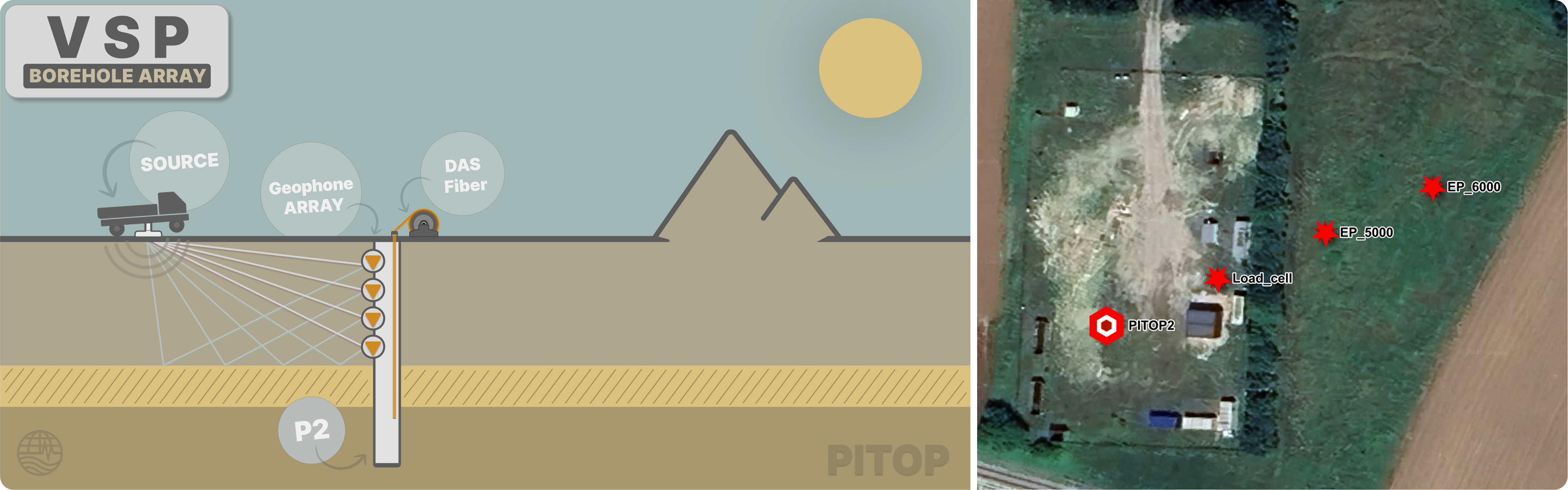
In questa pagina viene descritto l’esperimento Exp1 e sono messi a disposizione i relativi dataset per la comunità scientifica e industriale. Il test è un VSP eseguito nel pozzo PITOP2, utilizzando come sorgente un Vibroseis (Minivib) e come ricevitori sia un array di geofoni in foro sia una fibra ottica downhole (DAS). In this page, the experiment Exp1 is described and the relevant datasets are made available to the scientific and industrial community. This test is a VSP carried out in the well PITOP2, using a Vibroseis truck (Minivib) as the acoustic source and both a borehole geophone array and a downhole DAS fibre cable as receivers.
L’obiettivo di Exp1 è valutare la risposta DAS in configurazione VSP a PITOP2, confrontando le registrazioni della fibra downhole (interrogata con Silixa iDAS/Carina) con quelle di un array geofonico 3C co-locato, sotto energizzazione Vibroseis controllata. The objective of Exp1 is to evaluate DAS responses in a VSP configuration at PITOP2, comparing recordings from a downhole fibre cable interrogated by Silixa iDAS/Carina with a co-located 3C borehole geophone array, under controlled Vibroseis energization.
Layout dell’esperimento e strumentazione Layout of the experiment and equipment
Lo schema della configurazione di test è riportato in Figura 1. A sketch of the test configuration is reported in Figure 1.
Sito & Sorgenti Site & Source
- Luogo:Site location: PiTOP
- Sorgente:Source: Vibroseis Minivib (P mode)
Ricevitori e Interrogatori Receivers & Interrogators
- Ricevitori:Receivers: Geofoni 3C da pozzo; cavo DAS da pozzo Borehole 3C Geophones; DAS downhole cable
- Interrogatori:Interrogators: iDAS (Silixa Ltd); Carina (Silixa Ltd) iDAS (Silixa Ltd); Carina (Silixa Ltd)
Parametri principali di acquisizione Acquisition main parameters
| Parametro Parameter | Valore Value |
|---|---|
| Sweep length (s) | 16.0 |
| Start frequency (Hz) | 10.0 |
| Stop frequency (Hz) | 300.0 |
| Start taper (s) | 0.8 |
| Stop taper (s) | 0.8 |
| Load force (N) | 2200 |
| Parameter | Borehole geophones | Fiber Optics (iDAS) | Fiber Optics (Carina) |
|---|---|---|---|
| Tracf range | H1: 2101 - 2130 H2: 2201 - 2230 Z: 2301 - 2330 | 12260 - 12934 | 22658 - 23000 |
| Number of channels | 90 | 675 | 343 |
| Number of samples | 18000 | 18000 | 18000 |
| Record length (s) | 18.0 | 18.0 | 18.0 |
| Sampling interval (s) | 0.001 | 0.001 | 0.001 |
| Spatial sampling (m) | 10 | 1.039 | 1.021 |
Dataset e geometria di misura Dataset and measurement geometry
Il dataset fornito consiste in 1 rilievo con 3 diversi punti di energizzazione con un offset di rispettivamente 25, 50, 75 metri dal pozzo. Tutti i dati sono forniti in formato SEG-Y. The provided data set consists of 1 survey with 3 different energization points with an offset of 25, 50, 75 meters from the well, respectively. All the data is provided in the SEG-Y format.
Contenuto dei file SEG-Y Contents of the SEG-Y files
- Dati di traccia per ciascun geofono o sensore Trace data for each geophone or sensor
- Posizione della sorgente e geometria Shot position and geometry
-
Parametri di acquisizione:
Acquisition parameters:
- Frequenza di campionamento Sample rate
- Numero di tracce Number of traces
- Durata di registrazione Record length
- Contenuto dell'Header Header information
Access to resources. Here you can find the technical document, the DOI landing page, and the data folder.
For citation purposes, please refer to the DOI provided.
Esperimento “Exp2” Experiment “Exp2”
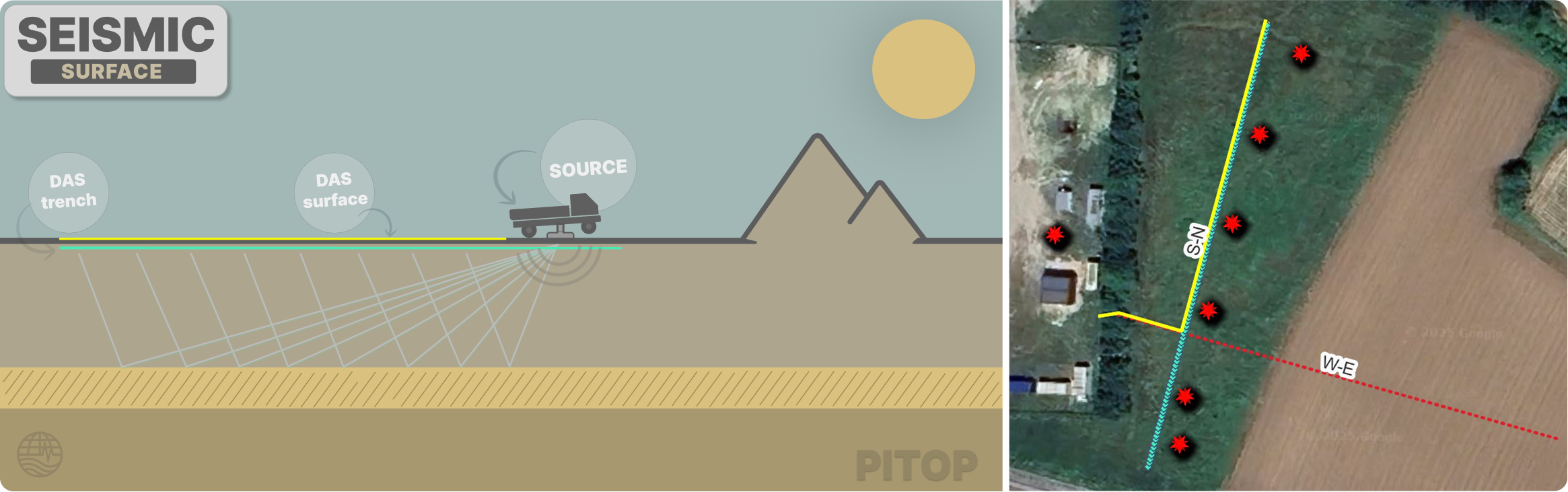
In questa pagina viene descritto l’esperimento “Exp2” e vengono messi a disposizione i relativi dataset per la comunità scientifica e industriale. L’attività è focalizzata su uno studio di sismica di superficie, con un Vibroseis (Minivib) come sorgente acustica e cavi in fibra ottica DAS (sia in trincea sia in superficie) come ricevitori. In this page, the experiment “Exp2” is described and the relevant datasets are made available to the scientific and industrial community. It is focused on a surface seismic study, using a Vibroseis truck (Minivib) as the acoustic source and DAS fibre cables (both in trenches and on the surface) as receivers.
L’obiettivo di Exp2 è indagare i segnali di un’acquisizione sismica attiva tramite cavi DAS posati in trincee poco profonde e in superficie, confrontando le registrazioni provenienti da vari tipi di cavo DAS (ad es. standard, constellation, HWC) e da differenti profondità, interrogati con Silixa iDAS/Carina e con una energizzazione Vibroseis (Minivib) controllata. I risultati di questo esperimento mirano a fornire un’ulteriore comprensione del comportamento di diverse tipologie di fibra inserite nello stesso cavo. Inoltre, il confronto tra dati acquisiti con fibre posate in superficie e in trincee poco profonde (50–100 cm) nella stessa posizione di superficie è volto a esplorare la possibilità di eseguire rilievi DAS senza operazioni di scavo estese, così da semplificare la logistica. The objective of Exp2 is to investigate the signals from an active seismic acquisition by DAS cables in shallow trenches and at surface, comparing recordings from various types of DAS cables (e.g. standard, constellation, HWC) and from different depth, interrogated by Silixa iDAS/Carina under controlled Vibroseis (Minivib) energization. The results of this experiment are aimed to provide a further insight on the behavior of different fibre types embedded in the same cable. Moreover, the data comparison from fibres deployed at the surface and in shallow trenches (50-100 cm) in the same surface position are aimed to explore the possibility to perform DAS surveys without extensive digging operations in order to facilitate logistics.
Layout dell’esperimento e strumentazione Layout of the experiment and equipment
Lo schema della configurazione di test è riportato in Figura 1. A sketch of the test configuration is reported in Figure 1.
Sito & Sorgenti Site & Source
- Luogo:Site location: PiTOP
- Sorgente:Source: Vibroseis Minivib (P mode)
Ricevitori e Interrogatori Receivers & Interrogators
- Ricevitori:Receivers: Cavi DAS DAS cables
- Interrogatori:Interrogators: iDAS (Silixa Ltd); Carina (Silixa Ltd) iDAS (Silixa Ltd); Carina (Silixa Ltd)
Parametri principali di acquisizione Acquisition main parameters
| Parametro Parameter | Valore Value |
|---|---|
| Sweep length (s) | 16.0 |
| Start frequency (Hz) | 10.0 |
| Stop frequency (Hz) | 300.0 |
| Start taper (s) | 0.8 |
| Stop taper (s) | 0.8 |
| Load force (N) | 2200 |
| Parameter type | Standard DAS (surface, P4 well) | Standard DAS (trench) | HWC SM (iDAS) | HWC CF (Carina) |
|---|---|---|---|---|
| Tracf range | 30265 - 30754 | 40483 - 40909 | 12508 - 12738 | 22693 - 22793 |
| Number of channels | 355 | 392 | 198 | 101 |
| Number of samples | 18000 | 18000 | 18000 | 18000 |
| Record length (s) | 18.0 | 18.0 | 18.0 | 18.0 |
| Sampling interval (s) | 0.001 | 0.001 | 0.001 | 0.001 |
| Spatial sampling (m) | 1.02 | 1.02 | 0.90 | 0.88 |
Dataset e geometria di misura Dataset and measurement geometry
Il dataset fornito consiste in 1 rilievo con diversi punti di energizzazione. Tutti i dati sono forniti in formato SEG-Y. The provided data set consists of 1 survey with several energization points. All the data is provided in the SEG-Y format.
Contenuto dei file SEG-Y Contents of the SEG-Y files
- Dati di traccia per ciascun geofono o sensore Trace data for each geophone or sensor
- Posizione della sorgente e geometria Shot position and geometry
-
Parametri di acquisizione:
Acquisition parameters:
- Frequenza di campionamento Sample rate
- Numero di tracce Number of traces
- Durata di registrazione Record length
- Contenuto dell'Header Header information
Access to resources. Here you can find the technical document, the DOI landing page, and the data folder.
For citation purposes, please refer to the DOI provided.
Esperimento “Exp3” Experiment “Exp3”
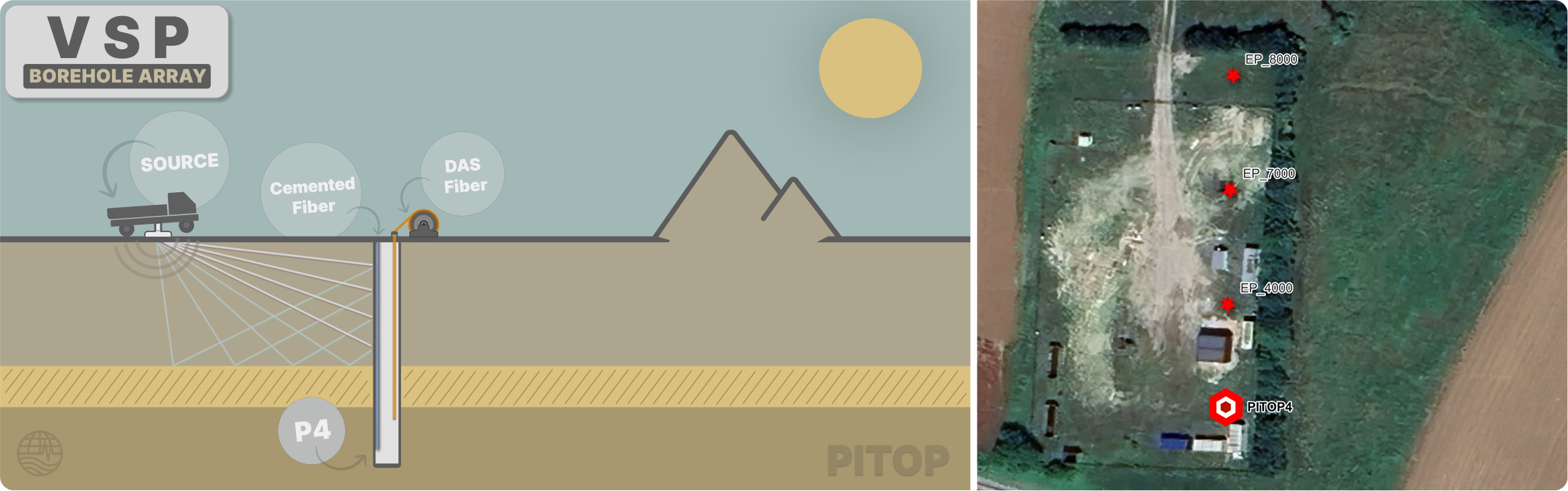
In questa pagina viene descritto l’esperimento Exp3 e vengono messi a disposizione i relativi dataset per la comunità scientifica e industriale. Il test è un VSP eseguito nel pozzo PITOP4, utilizzando un Vibroseis (Minivib) come sorgente acustica e sia fibre ottiche DAS downhole cementate sia sospese come ricevitori. In this page, experiment Exp3 is described and the relevant datasets are made available to the scientific and industrial community. This test is a VSP carried out in the well PITOP4, using a Vibroseis truck (Minivib) as the acoustic source and both cemented and suspended downhole DAS fibre cables as receivers.
L’obiettivo di Exp3 è valutare le risposte DAS in configurazione VSP a PITOP4, confrontando le registrazioni ottenute da un cavo in fibra downhole cementato o sospeso interrogato con Silixa iDAS/Carina, sotto energizzazione Vibroseis (Minivib) controllata. I cavi sospesi sono più semplici da installare rispetto a quelli cementati, ma possono comportare una qualità del segnale inferiore a causa di un accoppiamento cavo–formazione più debole. Il confronto dei dati di Exp3 mette in evidenza il diverso comportamento del segnale nelle due configurazioni e fornisce, in entrambi i casi, indicazioni sulla qualità del segnale. The objective of Exp3 is to evaluate DAS responses in a VSP configuration at PITOP4, comparing recordings from a cemented or suspended downhole fibre cable interrogated by Silixa iDAS/Carina, under controlled Vibroseis (Minivib) energization. Suspended cables are easier to install than cemented ones, but may result in poorer signal quality due to weaker cable coupling. The data comparison of Exp3 highlights the different signal behavior in the two configurations and provides, in both cases, indication about the signal quality.
Layout dell’esperimento e strumentazione Layout of the experiment and equipment
Lo schema della configurazione di test è riportato in Figura 1. A sketch of the test configuration is reported in Figure 1.
Sito & Sorgenti Site & Source
- Luogo:Site location: PiTOP
- Sorgente:Source: Vibroseis Minivib (P mode)
Ricevitori e Interrogatori Receivers & Interrogators
- Ricevitori:Receivers: Cavi DAS cementati e sospesi Cemented and suspended DAS cables
- Interrogatori:Interrogators: iDAS (Silixa Ltd); Carina (Silixa Ltd) iDAS (Silixa Ltd); Carina (Silixa Ltd)
Parametri principali di acquisizione Acquisition main parameters
| Parametro Parameter | Valore Value |
|---|---|
| Sweep length (s) | 16.0 |
| Start frequency (Hz) | 10.0 |
| Stop frequency (Hz) | 300.0 |
| Start taper (s) | 0.8 |
| Stop taper (s) | 0.8 |
| Load force (N) | 2200 |
| Parameter | Suspended DAS SM-DH (iDAS) looped | Cemented DAS SM-SE (iDAS) | Suspended DAS CF-DH (Carina) | Compact Rio (Load Cell) |
|---|---|---|---|---|
| Tracf range | 12465 - 12735 | 15025 - 15169 | 22655 - 22792 | 32084 |
| Number of channels | 270 | 144 | 137 | 1 |
| Number of samples | 18000 | 18000 | 18000 | 18000 |
| Record length (s) | 18.0 | 18.0 | 18.0 | 18.0 |
| Sampling interval (s) | 0.001 | 0.001 | 0.001 | 0.001 |
| Spatial sampling (m) | 1.039 | 1.039 | 1.021 | N.A. |
Dataset e geometria di misura Dataset and measurement geometry
Il dataset fornito consiste in 1 rilievo con diversi punti di energizzazione. Tutti i dati sono forniti in formato SEG-Y. The provided data set consists of 1 survey with several energization points. All the data is provided in the SEG-Y format.
Contenuto dei file SEG-Y Contents of the SEG-Y files
- Dati di traccia per ciascun geofono o sensore Trace data for each geophone or sensor
- Posizione della sorgente e geometria Shot position and geometry
-
Parametri di acquisizione:
Acquisition parameters:
- Frequenza di campionamento Sample rate
- Numero di tracce Number of traces
- Durata di registrazione Record length
- Contenuto dell'Header Header information
Access to resources. Here you can find the technical document, the DOI landing page, and the data folder.
For citation purposes, please refer to the DOI provided.
Experiment “Exp4”
Coming soon — short intro to Exp4 (add your summary paragraph here).